
NCERT Textbook Questions
Thinking
about the Text
(Page 50)
Question 1.
Here are some headings for paragraphs in the text. Write the number(s) of the
paragraph(s) for each title against the heading. The first one is done for you.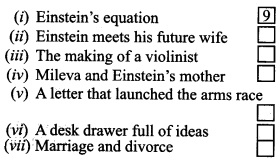
Answers: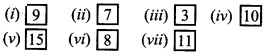
Question 2.
Who had these opinions about Einstein?
1.
He was boring.
2.
He was stupid and
would never succeed in life.
3.
He was a freak.
Answer:
1.
His playmates.
2.
A headmaster.
3.
His mother.
Question 3.
Explain what the reasons for the following are:
1.
Einstein leaving the
school in Munich for good.
2.
Einstein wanting to
study in Switzerland rather than in Munich.
3.
Einstein seeing in
Mileva an ally.
4.
What do these tell you
about Einstein?
Answers:
1.
Einstein left the
school in Munich because he did not like the discipline of the school. He hated
the school’s regimentation and often clashed with teachers.
2.
Albert’s parents moved
to Milan and left their son with relatives. After prolonged discussion,
Einstein got his wish to continue his education in German – speaking
Switzerland. Actually, it was more liberal than Munich.
3.
Einstein saw in Mileva
Marie an ally against the “Philistines”—those people in his family and at the
university with whom he was constantly at odds. He found that she was a “clever
creature”.
4.
These tell that
Einstein was a genius and had the capabilities to achieve his targets.
Moreover, he had his own view of life. He liked freedom too much.
Question 4.
What did Einstein call his desk drawer at the patent office? Why?
Answer:
Einstein called his desk drawer at the patent office the “bureau of theoretical
physics”. Einstein was actually developing his own ideas in secret and his
drawer had all the evidences which could reveal the secret.
Question 5.
Why did Einstein write a letter to Franklin Roosevelt?
Answer:
With the emergence of Nazis in Germany,
Einstein emigrated to the United States. It was the fact that the Nazis had the
ability to develop the atomic bomb. It could destroy the whole world. So he
warned Franklin D. Roosevelt in his letter.
Question 6.
How did Einstein react to the bombing of Hiroshima and Nagasaki?
Answer:
The atomic bomb devastated the Japanese cities of Hiroshima and Nagasaki. He
was deeply shaken by the extent of the destruction and wrote a public missive
to the United Nations.
Question 7.
Why does the world remember Einstein as a ‘world citizen’?
Answer:
The world remembers Einstein as a ‘world citizen’ because he believed in
universal peace. When there was the rat race for becoming atomic power, he was
worried about the aftermaths of the bomb. He was really a world citizen who was
concerned with humanity.
Question 8.
Here are some facts from Einstein’s life. Arrange them in chronological order.
[ ] Einstein publishes
his special theory of relativity.
[ ] He is awarded the Nobel Prize in Physics.
[ ] Einstein writes a letter to U.S. President, Franklin D. Roosevelt, and
warns against Germany’s building of an atomic bomb.
[ ] Einstein attends a high school in Munich.
[ ] Einstein’s family moves to Milan.
[ ] Einstein is bom in the German city of Ulm.
[ ] Einstein joins a University in Zurich, where he meets Mileva.
[ ] Einstein dies.
[ ] He provides a new interpretation of gravity.
[ ] Tired of the school’s regimentation, Einstein withdraws from school.
[ ] He works in a patent office as a technical expert.
[ ] When Hitler comes to power, Einstein leaves Germany for the United States.
Answers:
[1] Einstein is bom in
the German city of Ulm.
[2] Einstein attends a high school in Munich.
[3] Einstein’s family moves to Milan.
[4] Tired of the school’s regimentation, Einstein withdraws from school.
[5] Einstein joins a University in Zurich where he meets Mileva.
[6] He works in a patent office as a technical expert.
[7] Einstein publishes his special theory of relativity.
[8] He provides a new interpretation of gravitation.
[9] He is awarded the Nobel Prize in Physics.
[10] When Hitler comes to power, Einstein leaves Germany for the United States.
[11] Einstein writes a letter to U.S. President, Franklin D. Roosevelt and
warns against Germany’s building of an atomic bomb.
[12] Einstein dies.
Thinking
about language
(Page
51)
Question 1.
Here are some sentences from the story.
Choose the word from the brackets which can be substituted for the italicised
words in the sentences.
1.
A few years later, the
marriage faltered, (failed, broke, became weak)
2.
Einstein was
constantly at odds with people at the university, (on bad terms, in
disagreement, unhappy)
3.
The newspapers
proclaimed his work as “a scientific revolution”, (declared, praised, showed)
4.
Einstein got ever more
involved in politics, agitating for an end to the arms build up. (campaigning,
fighting, supporting)
5.
At the age of 15,
Einstein felt so stifled that he left the school for good. (permanently, for
his benefit, for a short time)
6.
Five years later, the
discovery of nuclear fission in Berlin had American physicists in an uproar,
(in a state of commotion, full of criticism, in a desperate state)
7.
Science wasn’t the
only thing that appealed to the dashing young man with the walrus moustache,
(interested, challenged, worried)
Answers:
1.
failed
2.
in disagreement
3.
declared
4.
campaigning
5.
permanently
6.
in a state of
commotion
7.
interested.
Question 2.
Study the following sentences:
·
Einstein became a
gifted amateur violinist, maintaining this skill throughout his life.
·
Letters survive in
which they put their affection into words, mixing science with tenderness.
The parts in italics
in the above sentences begin with ing verbs, and are called participial
phrases. Participial phrases say something more about the person or thing
talked about or the idea expressed by the sentence as a whole. For example:
—Einstein became a
gifted amateur violinist. He maintained this skill throughout his life.
Complete the sentences
below by filling in the blanks with suitable participial clauses. The
information that has to be used in the phrases is provided as a sentence in
brackets.
1.
……………. the
firefighters finally put out the fire. (They worked round the clock.)
2.
She watched the sunset
above the mountain, ……………. (She noticed the colours blending softly into one
another.)
3.
The excited horse
pawed the ground rapidly, ……………. (While it neighed continually.)
4.
……………. ,I found myself
in Bangalore, instead of Benaras. (I had taken the wrong train.)
5.
……………., I was
desperate to get to the bathroom. (I had not bathed for two days)
6.
The stone steps,
……………. needed to be replaced. (They were worn down).
7.
The actor received
hundreds of letters from his fans, ……………. (They asked him to send them his
photograph.)
Answers:
1.
Working round the
clock the firefighters finally put out the fire.
2.
Noticing the colours
blending softly into one another she watched the sunset above the mountain.
3.
Neighing continually
the excited horse pawed the ground rapidly.
4.
Having taken the wrong
train I found myself in Bangalore instead of Benaras.
5.
Having not bathed for
two days I was desperate to get to the bathroom.
6.
The stone steps being
worn down needed to be replaced.
7.
The actor received
hundreds of letters from his fans asking him to send them his photograph.
Writing
newspaper reports
(Page
53)
Here are some notes
which you could use to write a report.
21 August
2005—original handwritten manuscript of Albert Einstein unearthed— by student
Rowdy Boeynik in the Univer¬sity of Netherlands—Boeynik researching
papers—papers belonging to an old friend of Einstein—fingerprints of Einstein
on these papers—16 page document dated 1924—Einstein’s work on this last
the¬ory—behaviour of atoms at low temper¬ature—now known as the Bose-Einstein
condensation—the manuscript to be kept at Leyden University where Einstein got
the Nobel Prize.
Question 1.
Write a report which has four paragraphs,
one each on :
·
what was unearthed.
·
who unearthed it and
when.
·
what the document
contained.
·
where it will be kept.
Your report could
begin like this:
Answers:
Student Unearths Einstein Manuscript 21 August 2005. An original handwritten
Albert Einstein manuscript has been un-earthed at a University of Netherlands.
A student named Rowdy
Boeynik was researching on the papers belonging to his old companion Einstein.
The document contained
papers of Ein-stein’s work on the last theory—Behav¬iour of Atoms at Low
Temperature. Now¬adays it is known as the Bose-Einstein Condensation.
The manuscript will be
kept at Leyden University where Einstein got the Nobel Prize.
Dictation
(Page
53)
Question 1.
Your teacher will dictate these paragraphs to you. Write down the paragraphs
with correct punctuation marks.
In 1931 Charlie
Chaplin invited Albert Einstein, who was visiting Hollywood, to a private
screening of his new film, City Lights. As the two men drove into town
together, passersby waved and cheered. Chaplin turned to his guest and
explained: “The people are applauding you because none of them understands you
and applauding me because everybody understands me.”
One of Einstein’s
colleagues asked him for his telephone number one day. Einstein reached for a
telephone directory and looked it up. “You don’t remember your own number?” the
man asked, startled. “No,” Einstein answered. “Why should I memorise something
I can so easily get from a book?” (In fact, Einstein claimed never to memorise
anything which could be looked up in less than two minutes.)
Answer:
In 1931, Charlie Chaplin invited Albert Einstein, who was visiting Hollywood,
to a private screening of his new film, “City Lights”. As the two men drove
into town together, passers-by waved and cheered. Chaplin turned to his guest
and explained: “The people are applauding you because none of them understands
you and applauding me because everybody understands me.”
One of Einstein’s
colleagues asked him for his telephone number one day. Einstein reached for a
telephone directory and looked it up. “You don’t remember your own number?” the
man asked, startled. “No”, Einstein answered. “Why should I memorise something
I can so easily get from a book?” (In fact, Einstein claimed never to memorise
anything which could be looked up in less than two minutes.)
Extract
Based Questions(3 marks each)
Read
the passage given below and answer the questions that follow:
Question 1:
A headmaster once told his father thatwhat Einstein chose as a profession
would not matter, because
“he will never make a success at anything”. Einstein began learning to play the
violin at the age of six, because his mother wanted him to. He later became a
gifted amateur violinist, maintaining this skill throughout his life.
1.
What was the
headmaster’s opinion about Einstein ?
2.
Why did Einstein learn
to play violin ?
3.
Find a word from the
passage that means “having great natural ability”.(Board Term 1,2012,
ELI-013)
Answer:
1.
The headmaster’s
opinion about Einstein was that he would never be successful in his life.
2.
Einstein learnt to
play the violin to fulfil the desire of his mother.
3.
Gifted.
Question 2:
Einstein was deeply shaken by the extent of the destruction. This time he
wrote a public missive to the United Nations. In it he proposed the formation
of a world government. Unlike the letter to Roosevelt, this one made no impact.
1.
What did Einstein
write and to whom ?
2.
Why did he write a letter
to Roosevelt earlier ?
3.
Find the word from the
extract that means – “a long and official letter”.(Board Term 1,2012,
ELI-027)
Answer:
1.
Einstein wrote a
public missive to the United Nations proposing the formation of a world
government.
2.
He wrote a letter to
Roosevelt earlier in which he warned him by saying, “a single bomb of
this type might very well destroy the whole part with some of the surrounding
territory”, i.e., a letter warning him for a bomb blast.
3.
Missive.
Question 3:
“The pair finally got married in January 1903, and had two sons. But a few
years later, the marriage faltered”.
1.
Name the “pair”
referred to in the above lines.
2.
What happened to their
marriage ?
3.
Which word from the
extract means “became weak” ? (Board Term 1,2012, ELI-029)
Answer:
1.
The pair referred to
in the above lines is of Albert Einstein and Mileva.
2.
Their marriage was not
successful.
3.
Faltered.
Question 4:
He also felt a special interest in a fellow student, Mileva Marie, whom he
found to be a “clever creature”. This young serb had come to Switzerland
because the University in Zurich was one of the few in Europe where women could
get degrees. Einstein saw in her an ally against the “philistines”- those
people in his family and at the university with whom he was constantly at odds.
1.
Who is “clever
creature” and “young serb” in the passage ?
2.
Why did the young serh
come to Switzerland ?
3.
What was the attitude
of Einstein towards the young serb ? (Board Term 1,2012, ELI-025)
Or
1.
Who felt special
interest in Mileva Marie and why ?
2.
Why did Mileva Marie
come to Switzerland ?
3.
Which word in the
passage means “softness” ? (Board Term 1,2012, ELI-036)
Answer:
1.
Mileva Marie, a fellow
student with Einstein is referred to as a “clever creature” and “young serb”.
2.
The young serb had
come to Switzerland because the university in Zurich was one of the few in
Europe where women could get degrees.
3.
Einstein was attracted
to her and he wanted to join her.
Or
1.
Albert Einstein felt a
special interest in Mileva Marie as he thought her to be a clever creature.
2.
Mileva Marie came to
Switzerland as the University of Zurich was one of the few places of Europe
where women could get degrees.
3.
Tenderness.
Short
Answer Type Questions (2 marks each)
(About
30-40 words each)
Question 1:
Why did the people call Einstein a world citizen ? (Board Term
1,2012, ELI-014)
Answer:
People called Einstein a world citizen because he campaigned for peace and
democracy and was agitated against arms and bombs especially after the bombing
of Hiroshima and Nagasaki.
Question 2:
Why did Albert Einstein leave his school ? (Board Term 1,2012, ELI-015)
Answer:
Albert Einstein left his school because he was not happy with the education
system. He was not at
ease with the strict regimentation of the school. He felt suffocated because of
which he had to leave school.
Question 3:
Why did Einstein hate school ? (Board Term 1,2012, ELI-018)
Answer:
He hated school regimentation because of its extreme sense of discipline. He
felt tired and suffocated
with this atmosphere. He often clashed with his teacher.
Question 4:
Why does the world remember Einstein as a world citizen ? (Board Term
1,2012, ELI-019)
Answer:
The world remembers Einstein as a world citizen as he was deeply hurt by the
mass destruction in
Japan and campaigned for peace and democracy – worked for humanity.
Question 5:
Why did Einstein write a letter to Franklin Roosevelt ?(Board Term 1,2012,
ELI-020)
Or
Why did Einstein write a letter to the American President Roosevelt ?(Board Term 1,2012,
ELI-042)
Answer:
Einstein wrote a letter to Franklin Roosevelt when the Nazis were in Germany
and he had to migrate
from there. The discovery of Nuclear fission in Germany made the American
physicists upset that the Nazis could use an atom bomb.
Question 6:
What is Einstein’s Special Theory of Relativity ? (Board Term
1,2012, ELI-021)
Answer:
According to Einstein’s special theory of relativity, time and distance are
not absolute. From this followed the world’s most famous formula which
describes the relationship between mass and energy i.e., E = me2.
Question 7:
Why did Einstein’s play mates call him “Brother Boring” ? (Board Term
1,2012, ELI-023)
Answer:
Einstein could not mix up with other children. He did not find their games
interesting. He often uttered every word twice. He was often teased for his
abnormally huge head. And so his friends nicknamed him “Brother Boring.”
Question 8:
How was Einstein’s private life unraveling after he finished his studies ?(Board Term 1,2012,
ELI-026)
Answer:
He had wanted to marry Mileva but his mother was against it. She thought
Mileva was three years older than her son and toq intelligent for him.
Question 9:
What did Einstein call his desk drawer at the patent office and why ?(Board Term 1,2012,
ELI- 028)
Answer:
Einstein called his desk drawer at the patent office the “bureau of theoretical
physics” because he was working as a technical expert in the patent office in
Bern where he was supposed to be assessing other peoples’ inventions.
Question 10:
How did Einstein react to the bombing of Hiroshima and Nagasaki ?(Board Term 1,2012,
ELI-034)
Answer:
Einstein was shocked at the extent of destruction caused by the bombing. He
wrote a long letter to the United Nations and suggested that there should be a
World Government.
Long
Answer Type Questions (4 marks each)
(About
80-100 words each)
Question 1:
Write down the achievements of Albert Einstein. (Board Term
1,2012, ELI-022)
Answer:
Albert Einstein was really a scientific genius. He felt at home in Mathematics
but he showed keen interest in physics. After graduating from the university in
Zurich he started working vigorously. With his university education he was
working on relativity. After his graduation, he remained jobless. So, he gave
private lessons. In 1902, he secured a job as a technical expert in the patent
office in Bera. But he went on developing his own ideas. The world showered on
him honors invitations. He was honored with Noble prize in 1921.
Question 2:
Einstein was an unusual child with no indication of his potential
greatness. Comment.(Board Term 1,2012, ELI-039)
Answer:
Einstein’s head was larger than the usual head. He was called “Brother Boring”
because he never mixed up with his classmates. He left school because he was
not happy with the strict regimentation. He loved mechanical toys and thought
his sister to be a toy. The head master thought him to be stupid and good for
nothing and that he would never succeed in life. He also told Einstein’s father
that whatever profession he chose would not matter, because “he will never make
a success at anything”. This proves that Einstein was an unusual child with no
indication of his potential greatness.
Question 3:
What was the outcome of Einstein’s letter which he wrote to the American
President, Roosevelt ? Did his warning have any impact on America ?(Board Term 1,2012,
ELI-051)
Answer:
On his colleague’s insistence, Einstein wrote a letter to the American
President, Roosevelt when the Nazis were in Germany and he had to migrate from
there. The discovery of Nuclear fission in Germany made the American physicists
upset that the Nazis could use the bomb. He warned him of the consequences of
the atomic bomb. His words had a great impact. The Americans developed the
atomic bomb secretly. They dropped it on the Japanese cities of Hiroshima and
Nagasaki irf August 1945. Einstein was greatly moved by the destruction. He
wrote a long letter to the United Nations and suggested that there should be a
world government. This definitely helped ending the world war.
Value
Based Question (4 marks)
Question 1:
Do you think that in today’s context national boundaries are overcome by
global issued ?
Answer:
The world is undoubtedly a global village. Any issue cannot be resolved at
the national level alone. This has been reflected in die case of Albert
Einstein. He wrote to the President of the U.S.A. about the evils of a nuclear
war, requesting him to take some measures. It is definitely the responsibility
of each one of us to shoulder the responsibility of protecting the world.


No comments:
Post a Comment